
Miami-Dade HVHZ Wind Load Requirements, Explained for Homeowners
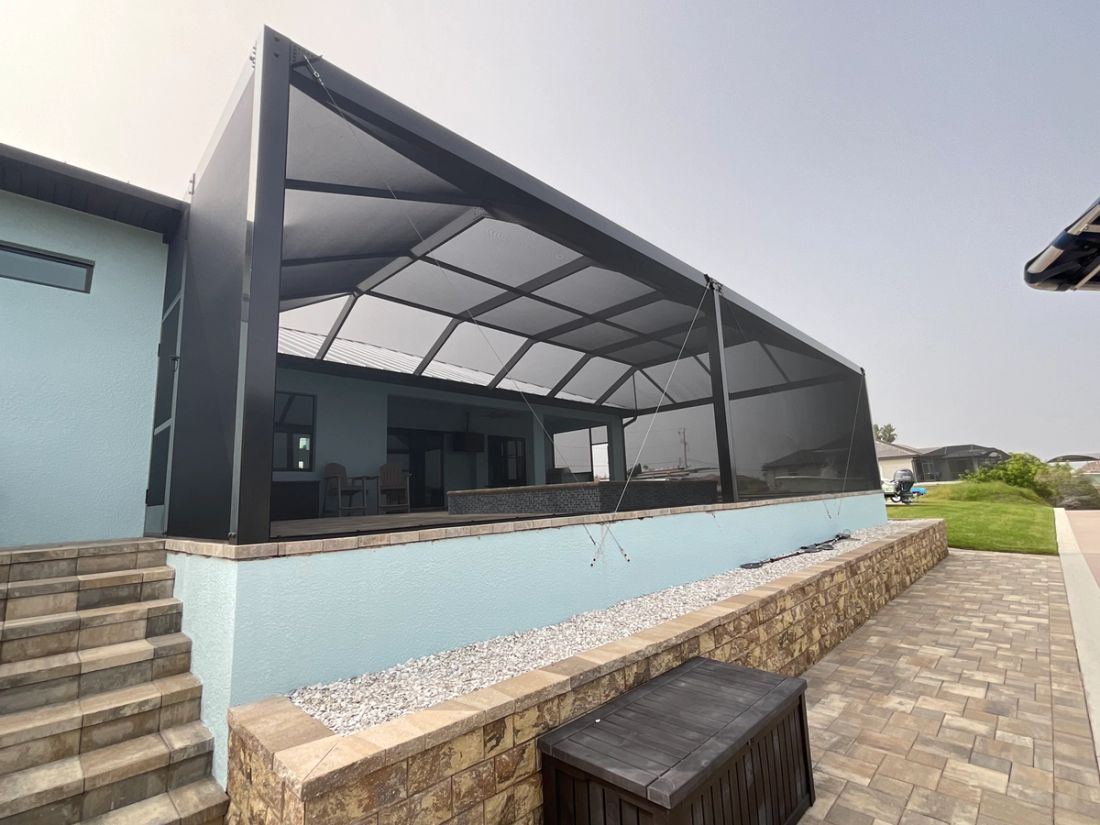
Miami-Dade and coastal Broward sit in a High-Velocity Hurricane Zone. Here is what HVHZ wind load requirements mean for an aluminum pergola, pool cage or screen room, in plain language.
Miami-Dade HVHZ wind load rules apply because the county sits inside Florida's High-Velocity Hurricane Zone, where the Florida Building Code requires outdoor structures to resist roughly 175 mph design wind speeds. For an aluminum pergola, pool enclosure or screen room, that shapes the gauge, the anchoring, the spacing and the product approval. The exact rating always depends on size, attachment and any add-ons.
If you live in Miami-Dade County, or along the coastal edge of Broward, your outdoor aluminum project is not judged by ordinary building rules. It falls under the High-Velocity Hurricane Zone, and that designation changes how a pergola, pool cage or screen room must be engineered, anchored and approved.
This guide explains HVHZ wind load requirements in plain language for homeowners weighing a project in places like Pinecrest, Coral Gables or coastal Hollywood. The goal is honest clarity.
What Is the High-Velocity Hurricane Zone?
The High-Velocity Hurricane Zone, or HVHZ, is a special wind region defined by the Florida Building Code. It covers all of Miami-Dade County and Broward County, where hurricane exposure is highest along the South Florida coast.
Inside the HVHZ, the code sets stricter standards for design wind speed, product testing and inspections than the rest of the state. Any permanent aluminum structure here must be engineered to HVHZ rules, and a contractor who ignores that is setting you up for a failed inspection.
What Wind Load Does the Florida Building Code Require?
Wind load is the force that wind exerts on a structure. The Florida Building Code translates that into a design wind speed, and within the HVHZ that figure commonly lands near 175 mph for many residential sites, depending on location and exposure.
That number does not mean a structure literally survives a 175 mph storm untouched. It means the components and connections are engineered and tested to resist calculated pressures tied to that design speed, with safety factors built in.
The real load on your structure depends on its height, footprint, roof type and lot position. A tall freestanding louvered roof in an open Weston backyard sees different pressures than a low cover tucked against a Pinecrest home.
What Does HVHZ Mean for Aluminum Pergolas and Pool Enclosures?
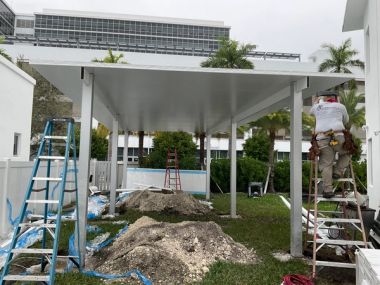
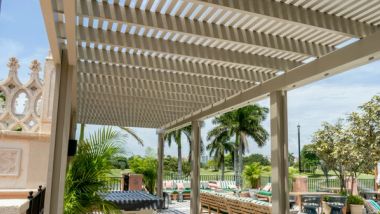
For an aluminum pergola, HVHZ rules influence post size, beam gauge, footing depth and the hardware that ties everything to the slab. Heavier wind zones generally mean thicker aluminum and more substantial anchors.
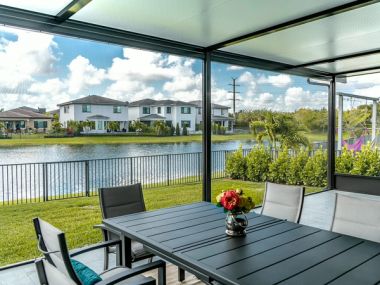
For a pool screen enclosure, the cage is a large, lightweight surface that catches wind, so beam spacing, anchor frequency and screen attachment all matter, and Mansard, hip and gable shapes each carry load differently. For a screen room, hurricane-rated mesh and reinforced framing can help, but they are one part of an engineered system, not a magic upgrade.
Anchoring and Attachment
Anchoring is where many projects pass or fail. The code dictates anchor type, embedment and spacing into the concrete, and attached structures must connect to the home in an engineered way. Weak anchoring undermines good aluminum.
Gauge and Member Spacing
Gauge refers to the thickness of the aluminum. In the HVHZ, larger spans and exposed sites often require heavier members and tighter spacing so the structure resists uplift and lateral pressure without flexing past its limits.
What Is an NOA and Why Does It Matter in Miami-Dade?
An NOA, or Notice of Acceptance, is a Miami-Dade County approval confirming a product or system has been tested to HVHZ standards. Inspectors look for NOA documentation on covered components during permitting.
NOAs matter because they prove materials were independently evaluated for high-wind performance. A product with no NOA or comparable state approval where required can stall your permit, so asking about approvals early prevents delays in cities like Coral Springs or Cutler Bay.
What HVHZ Requires for Your Outdoor Project
Every site is different, but HVHZ compliance for a residential aluminum structure generally touches the points below. Use this as a checklist of questions for any contractor you interview in South Florida.
- Engineered design tied to the site-specific design wind speed
- Aluminum gauge and member sizing suited to the span and exposure
- Approved anchoring with correct embedment and spacing into concrete
- Engineered attachment to the home for attached structures
- Product approvals (NOA or state approval) on covered components
- Wind-rated screen and fastening details on enclosures, where specified
- A permit pulled with the local Miami-Dade or Broward building department
- Scheduled inspections at the required stages of the build
- Documentation kept on file for the inspector and the homeowner
None of these steps are optional in the HVHZ. Skipping any of them risks a failed inspection, a stalled project, or a structure that does not perform the way it should in a storm.
An Honest Word on Hurricane Performance
It is tempting to want a contractor to promise a pergola or pool cage will survive any hurricane. We will not make that claim, because it is not honest, and Florida storms do not respect marketing language.
What we can say is that we engineer to the Florida Building Code and, in Miami-Dade, to HVHZ wind load requirements where they apply. The specific rating of your structure depends on its type, size, attachment and any add-ons like motorized louvers. A well-engineered structure with correct anchoring and approved components is built to resist the design loads the code requires.
How AB Aluminum & Screens Handles HVHZ Projects
We handle design, permits and installation in house, so one accountable team manages your project from the first sketch through final inspection in Miami-Dade, Broward and Palm Beach.
We render your pergola, pool enclosure or screen room in 3D so you can walk through the design before we cut a single piece of aluminum, and we quote real numbers from that design. Explore our aluminum pool enclosure installation in South Florida or our custom aluminum pergola options for Miami-Dade homes to see where your project fits.
With 15+ years of experience, a licensed and insured crew, a bilingual team and financing through Synchrony Bank, we make the HVHZ process clear for homeowners across South Florida.
Frequently Asked Questions
What is the HVHZ in Miami-Dade?
The HVHZ, or High-Velocity Hurricane Zone, is a Florida Building Code wind region covering Miami-Dade and Broward counties. It imposes stricter design wind speeds, product testing and inspection rules than most of the state.
What wind speed must structures meet in Miami-Dade?
Within the HVHZ, many residential sites use a design wind speed near 175 mph, though the exact figure depends on location and exposure. It reflects engineered resistance to calculated pressures, not a guarantee against any storm.
Do I need an NOA for my pergola or pool enclosure?
Covered products and systems in Miami-Dade generally need a Notice of Acceptance or comparable state approval. Inspectors check this documentation during permitting, so it is worth confirming approvals with your contractor before work begins.
Does HVHZ engineering make my structure hurricane-proof?
No. HVHZ engineering means the structure is built to resist the wind loads the code requires for the site. The specific rating depends on size, attachment and add-ons, and no honest contractor promises survival of any hurricane.
Does HVHZ apply in Broward and Palm Beach?
The full HVHZ covers Miami-Dade and Broward counties, including coastal Broward cities. Palm Beach County sits in a high-wind region with strict requirements as well, though the formal HVHZ designation applies to Miami-Dade and Broward.
Schedule My Free 3D Design Consultation
Ready to plan an aluminum pergola, pool enclosure or screen room engineered for the HVHZ? Schedule My Free 3D Design Consultation and we will walk you through the code, the design and a real quote, with no upfront costs.
Call us in English at (786) 383-6066 or in Spanish at (786) 340-5157. We serve homeowners across Miami-Dade, Broward and Palm Beach, from Pinecrest and Coral Gables to Weston. Schedule My Free 3D Design Consultation today.